Address to Coordinates: Will Geocoding Decide the War Between Humans and AI?
How converting addresses to coordinates became AI’s missing sense. 461M addresses, 200+ countries, 2,000 years of history. The technology running your world.
In October 2019, I stood on stage at Big Data Ignite in Grand Rapids, Michigan, and made a prediction that got some uncomfortable laughs: the side that masters converting human addresses into machine coordinates will win the AI race. Five years later, nobody is laughing.
Converting an address to coordinates — called geocoding — is the process of translating a human-readable location like "350 5th Avenue, New York" into a pair of decimal numbers (40.7484, -73.9857) that pinpoint that exact spot on Earth. It is the technology that makes GPS navigation, food delivery, ride-sharing, emergency dispatch, and every AI system that interacts with the physical world possible. And it is far harder than most people realize.
Here’s the thing most people don’t realize: every breakthrough in AI — every self-driving car, every delivery drone, every emergency dispatch system — hits the same wall. The AI can think. It can see. It can speak. But it cannot find a building. It cannot convert "350 5th Avenue, New York" into the two numbers (40.7484, −73.9857) that mean the Empire State Building. That conversion — address to coordinates — is called geocoding. And it is quietly deciding who wins and who loses in the biggest technology shift of our lifetime.
This is the story of how a 2,000-year-old problem became the most important unsolved challenge in artificial intelligence. Buckle up.
You Used Coordinates 200 Times Before Lunch
Most people think coordinates are for pilots and ship captains. They’re wrong. You used latitude and longitude over 200 times before noon today — you just didn’t know it. Every app on your phone, every notification, every delivery estimate is powered by the same invisible conversion: address to coordinates.
Here’s what your morning actually looked like, behind the screen:
⏰ Your Alarm
Your phone used GPS coordinates to calculate sunrise for your city. That "smart alarm" feature? It geocoded your location while you slept.
🚕 Your Ride
You typed "office" into Uber. Behind the scenes, your pickup address and destination were both converted to coordinates. Two geocoding operations, one tap.
☕ Your Coffee
Starbucks app showed "3 min walk." It geocoded your address, geocoded the store, calculated the route — all before you finished reading the notification.
🌦️ Your Weather
That forecast? Your coordinates were mapped to a lat/long grid cell. Weather is not predicted for "your city" — it is predicted for your exact coordinate pair.
💬 Your Slack
Colleague shared a meeting location. The map preview? Geocoded. The "15 min drive" estimate? Geocoded again. Two more conversions you never noticed.
🍜 Your Lunch
DoorDash estimated 28 minutes. It geocoded the restaurant, geocoded your office, ran a routing algorithm across both coordinate pairs, and factored in traffic — all in under a second.
That’s six examples. The real number is closer to 200. Every search result with a map, every ETA, every "near you" recommendation — all geocoding. All invisible. All converting your messy human address into precise machine coordinates.
AI Has Every Sense Except One
Let me tell you something that keeps AI researchers up at night. In 2026, artificial intelligence can see — image recognition surpassed human accuracy in 2015. It can hear — speech recognition works in 100+ languages. It can speak — large language models write essays, code, and poetry. It can reason — it solves math olympiad problems and writes production software.
But it cannot act in the physical world without one thing: knowing WHERE.
Think about it. An autonomous delivery vehicle can identify a stop sign from 300 meters. It can navigate intersections, detect pedestrians, adjust speed for weather. But if you tell it "deliver this package to 350 5th Avenue, New York" — it has no idea where that is. Not unless something converts that string of characters into the coordinate pair 40.7484, −73.9857.
Without geocoding, a $200,000 autonomous vehicle is a very expensive paperweight. A drone delivery fleet is a swarm of confused robots. A 911 dispatch system is a phone that rings but cannot send help. Geocoding is not a feature of AI. It is the bridge between digital intelligence and the physical world. It is AI’s missing sense.

The Address Problem: Human Poetry vs Machine Precision
Here’s why this problem is so hard. Addresses were never designed for machines. They were designed for letter carriers and taxi drivers and people who give directions like "turn left at the big tree." They are, fundamentally, a human invention — messy, inconsistent, beautiful in their chaos.
In Costa Rica, a legal address might read: "200 meters south and 50 meters east of the old fig tree in San José." That is a real address. It works. Mail gets delivered. But try feeding that to a computer. In Japan, streets don’t have names — buildings are numbered by the order they were constructed. Block 3, Building 7 might be next to Building 15 because that’s when it was built. In Germany, the house number comes after the street name. In the United States, it comes before. In some rural parts of Brazil, addresses reference landmarks that no longer exist.
The scale of this chaos is staggering. Researchers estimate there are over 135,000 possible address component combinations worldwide. Here’s a sample:
| Country | Format | Example |
|---|---|---|
| United States | Number before street | 350 5th Avenue, New York, NY 10118 |
| Germany | Number after street | Friedrichstraße 43-45, 10117 Berlin |
| Japan | No street names | 東京都港区苝1-2-3 (Minato City, Block 1, Lot 2, Building 3) |
| Costa Rica | Landmark-based | 200m south of the old fig tree, San José |
| Brazil | State abbreviation last | Av. Paulista, 1578 - Bela Vista, São Paulo - SP |
| Spain | Floor and door included | Calle Gran Vía 28, 3º Izq, 28013 Madrid |
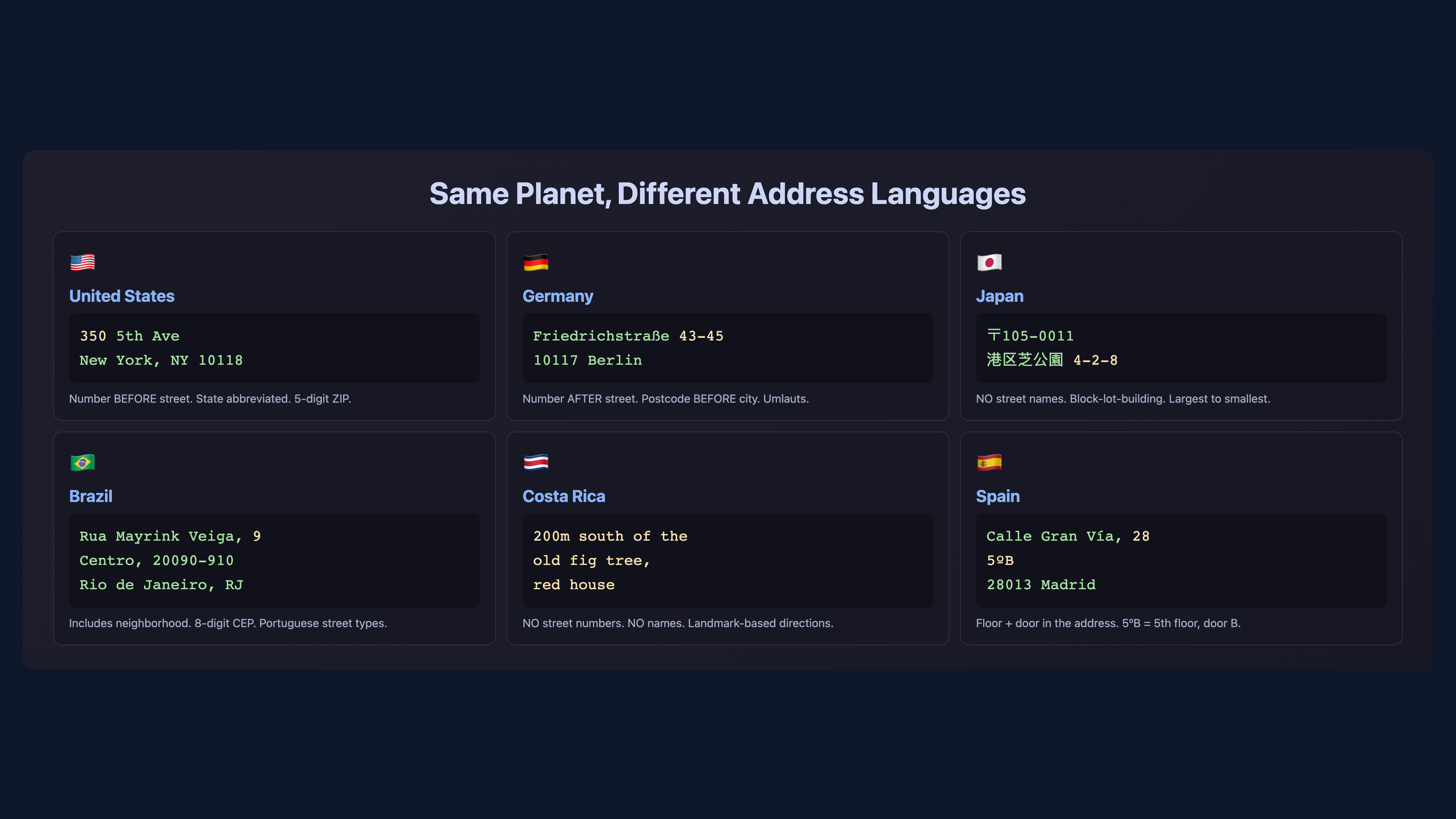
Same planet, same goal (find the building), completely different languages for describing where it is. A geocoder must understand all of them. That is not an engineering problem — it is a linguistics problem, a cultural problem, and a data problem, all at once.
2,000 Years to Map the World
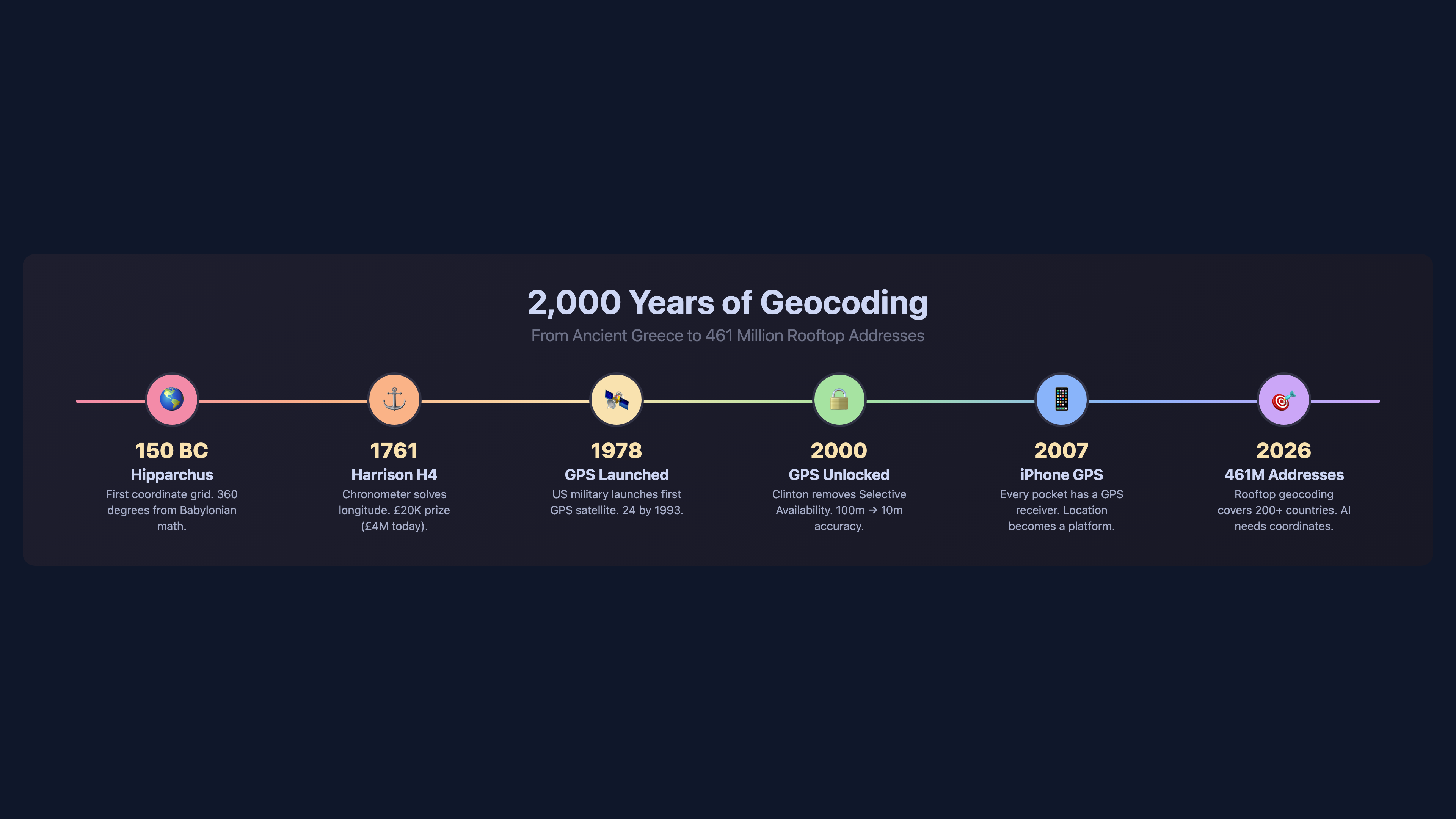
The dream of converting places into numbers is not new. It’s 2,000 years old. Around 150 BC, the Greek astronomer Hipparchus proposed dividing the Earth into a 360-degree grid — latitude and longitude. Brilliant idea. One problem: he had no way to measure longitude at sea. Ships kept sinking because navigators couldn’t figure out where they were.
That problem persisted for nearly two millennia. In 1714, the British government offered a prize of £20,000 (about £4 million in today’s money) to anyone who could solve the longitude problem. In 1761, a self-taught clockmaker named John Harrison won it — not with astronomy, but with a clock. His marine chronometer H4 was so precise that sailors could calculate their longitude by comparing local noon to Greenwich time. A clock solved what telescopes couldn’t.
Fast forward to 1978: the United States military launched the first GPS satellite. By 1993, the constellation was complete — 24 satellites, global coverage. But it was military-only, deliberately degraded for civilians to 100-meter accuracy. You could tell you were in the right neighborhood, but not the right building.
On May 1, 2000, President Clinton signed an executive order turning off Selective Availability. Overnight, civilian GPS accuracy jumped from 100 meters to about 10 meters. Seven years later, Steve Jobs put GPS into the iPhone. Suddenly, 3 billion people had centimeter-level positioning in their pockets.
And today? We have 744 million rooftop-level addresses mapped across 200+ countries. Not city centers. Not postal code centroids. Individual rooftops. The 2,000-year journey from Hipparchus’s dream to 744 million pinpoints on a map is complete.
Follow One Address Through the Pipeline
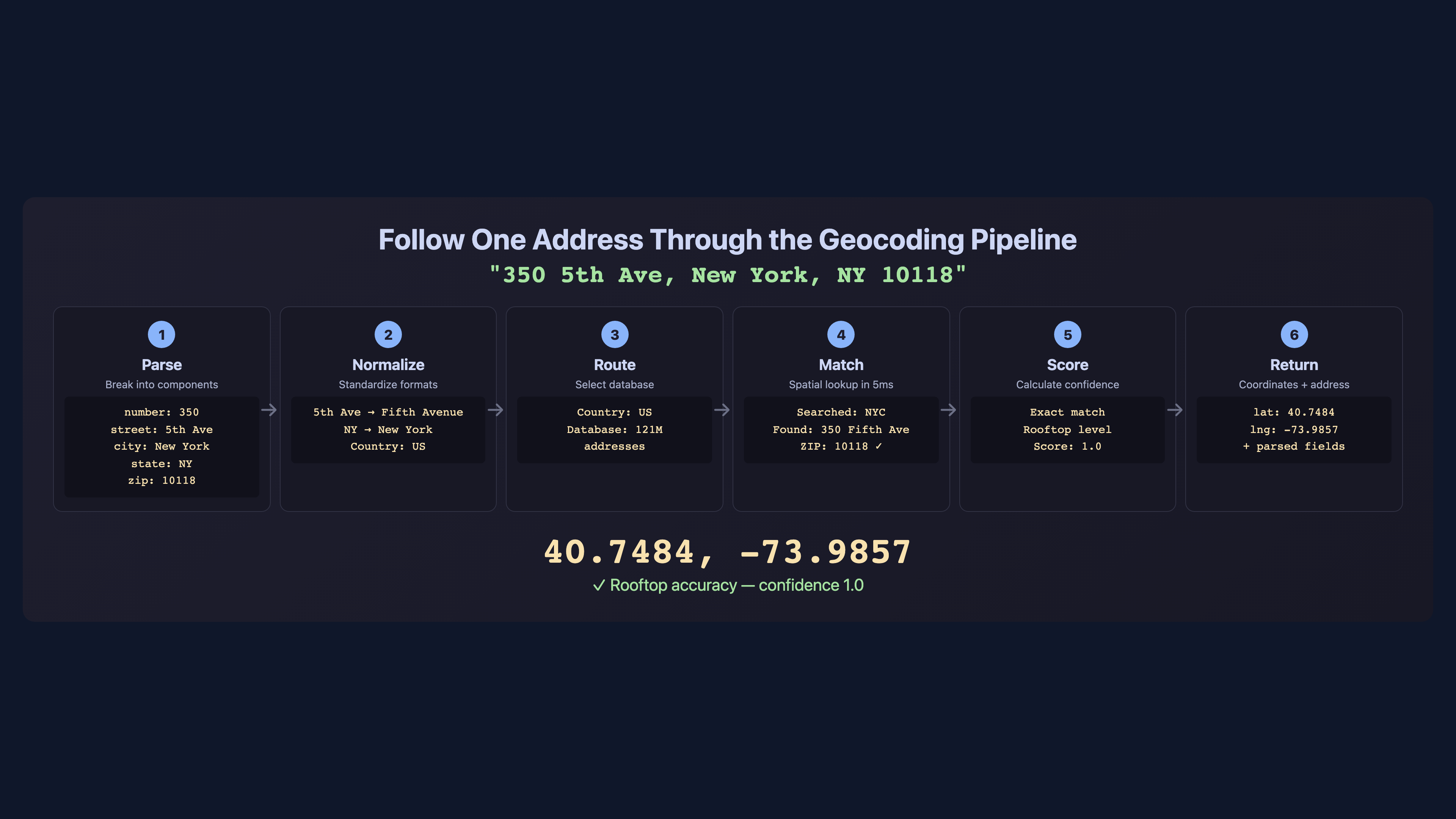
Let’s make this concrete. You type an address into a search bar: "350 5th Ave, New York, NY 10118." What happens in the next 5 milliseconds is one of the most impressive feats of engineering most people will never see.
Step 1: Parse. The geocoder breaks the raw string into components. "350" is a house number. "5th Ave" is a street. "New York" is a city. "NY" is a state. "10118" is a postal code. This sounds simple until you remember Costa Rica’s fig trees and Japan’s unnamed streets.
Step 2: Normalize. "5th Ave" becomes "Fifth Avenue." "NY" becomes "New York." "St." becomes "Street." Abbreviations, misspellings, and alternate names are all resolved into canonical forms. The geocoder handles thousands of these transformations per country.
Step 3: Route. The system determines which country dataset to search. The US alone has 121 million addresses. Germany has 22 million. The geocoder doesn’t search all 744 million — it narrows to the right country, then the right region, in microseconds.
Step 4: Match. This is the core. The normalized components are compared against the address database using multiple search strategies. Exact match on postcode. Fuzzy match on street name. Fallback to city centroid if the street isn’t found. Eight different strategies, tried in order, from most precise to least.
Step 5: Score. Each candidate result gets a confidence score from 0 to 1.0. A score of 1.0 means rooftop-level precision — the geocoder found the exact building. A score of 0.5 means it matched the street but not the building. Below 0.3, you’re at postal code level.
Step 6: Return. The winning result is returned: latitude 40.7484, longitude −73.9857, confidence 1.0. The Empire State Building. Five milliseconds, start to finish. One hundred and twenty-one million addresses searched, matched, scored, and delivered before you finished blinking.
What Coordinates Unlock
Once an address becomes a coordinate pair, entirely new capabilities emerge. Each of the following is a billion-dollar industry built on one foundation: converting addresses to coordinates.
- Route Optimization — Logistics companies save millions by optimizing delivery routes across geocoded addresses. FedEx, UPS, and Amazon route 50+ million packages daily using coordinate-based algorithms.
- Spatial Analysis — Insurance companies price policies based on proximity to flood zones, fire stations, and crime clusters. Every property is geocoded and scored against geographic risk layers.
- Emergency Dispatch — When you call 911, your phone transmits coordinates. Dispatchers see your exact building, not your neighborhood. Seconds saved by precise geocoding save lives.
- Autonomous Navigation — Self-driving vehicles, delivery drones, and robots all convert destination addresses to coordinates before they move a single inch.
- Geofencing — "Send a push notification when a customer is within 200 meters of our store." That radius is calculated from the store’s geocoded coordinates.
- CRM Enrichment — Sales teams geocode customer addresses to build territory maps, identify geographic clusters, and plan field visits. A spreadsheet of addresses becomes a visual strategy.
Every address-to-coordinate conversion includes a confidence score that tells you how precise the result is:
| Confidence Score | Accuracy Level | What It Means |
|---|---|---|
| 1.0 | Rooftop | Exact building match — coordinates point to the specific address |
| 0.8–0.99 | Near-rooftop | Correct building or parcel — very reliable for mapping and routing |
| 0.5–0.79 | Street-level | Correct street, approximate position — house number not in database |
| Below 0.5 | Area-level | City or postal code centroid — address was too vague or not found |
Convert Your Addresses to Coordinates
Enough theory. If you’re here because you need to convert addresses to coordinates, here are three ways to do it right now — from zero-code to full API integration.
Method 1: Free Online Batch Geocoding. Go to csv2geo.com/batchgeocoding, upload a CSV or Excel file with addresses, map your columns, and download a file with latitude and longitude added. 100 rows per day, free, no sign-up required.
Method 2: CSV/Excel File Upload. For larger files, create a free account and upload CSV or Excel files with up to 100 free rows per day. Results include coordinates, confidence scores, and matched address components for 200+ countries. See the step-by-step CSV guide.
Method 3: API Integration. The CSV2GEO API provides 18 endpoints for forward, reverse, and batch geocoding across 200+ countries with 744M+ addresses. 1,000 free requests per day. Get your API key at csv2geo.com/api-keys.
Quick API example:
# cURL — geocode a single address
curl "https://csv2geo.com/api/v1/geocode?q=350+5th+Ave,+New+York&country=US&api_key=YOUR_KEY"
# Python — geocode with the SDK
from csv2geo import Client
client = Client(api_key="geo_live_your_key_here")
result = client.geocode("350 5th Ave, New York", country="US")
print(f"{result.latitude}, {result.longitude}") # 40.7484, -73.9857
Need to go the other direction? Convert coordinates back to addresses with [Link: reverse geocoding | https://csv2geo.com/reversegeocoding]. Full documentation and examples at the Help center. Or see our [Link: Python geocoding guide | https://csv2geo.com/blog/how-to-geocode-addresses-in-python] for complete code examples.
This Is Part 1 of a Series
You just learned why geocoding matters and how address-to-coordinate conversion works at a high level. But we’re just getting started.
In Part 2, we’ll blow your mind with the house number problem — why "123" is not what you think, and how geocoders handle buildings that have three different numbers depending on which door you use. In Part 3, we’ll explore 200 countries and 200 ways to write an address — from Japanese blocks to Brazilian favelas to What3Words. And in Part 4, we’ll give you the practical tools to convert any address on Earth to coordinates, with working code in Python, JavaScript, and cURL.
Subscribe to the blog or bookmark this page. You won’t want to miss what comes next.
Frequently Asked Questions
What does "address to coordinates" mean?
"Address to coordinates" (also called geocoding) is the process of converting a human-readable street address like "350 5th Avenue, New York, NY 10118" into a pair of geographic coordinates: latitude 40.7484, longitude −73.9857. These two numbers pinpoint the exact location on Earth and enable mapping, routing, spatial analysis, and navigation.
How do you convert an address to coordinates?
You can convert an address to coordinates using a geocoding service. Upload a CSV or Excel file at csv2geo.com/batchgeocoding for a no-code solution, or use the CSV2GEO API to geocode programmatically. The service parses the address, normalizes it, searches 744M+ addresses across 200+ countries, and returns latitude and longitude with a confidence score.
Why can’t AI work without coordinates?
AI can process text, images, and speech, but it cannot interact with the physical world without knowing WHERE. Autonomous vehicles, delivery drones, emergency dispatch, and logistics optimization all require converting human addresses into machine-readable coordinates. Without geocoding, AI has no spatial awareness — it can think but cannot navigate.
How accurate is address-to-coordinate conversion?
Modern geocoding achieves rooftop-level accuracy (within 1–5 meters of the actual building) for well-formatted addresses in countries with comprehensive address databases. CSV2GEO returns a confidence score from 0 to 1.0 with every result: 1.0 means exact rooftop match, 0.8–0.99 is near-rooftop, 0.5–0.79 is street-level, and below 0.5 is area-level (city or postal code centroid).
How many address formats exist worldwide?
Researchers estimate over 135,000 possible address component combinations worldwide. Formats vary by country (number before or after street name), region (landmark-based vs. grid-based), and culture (Japan has no street names, Costa Rica uses distances from landmarks). A geocoder must understand all these variations to convert addresses from 200+ countries.
Is address-to-coordinate conversion free?
Yes. CSV2GEO offers free geocoding with two options: upload CSV or Excel files at csv2geo.com/batchgeocoding (100 rows per day free) or use the API (1,000 free requests per day, no credit card required). Get your API key at csv2geo.com/api-keys.
What coordinate system is used?
Geocoding services return coordinates in the WGS84 coordinate system (World Geodetic System 1984), the same system used by GPS satellites and virtually all mapping applications. Coordinates are expressed as decimal degrees: latitude (−90 to +90, north-south) and longitude (−180 to +180, east-west).
Can you convert coordinates back to addresses?
Yes. The reverse process is called reverse geocoding — converting latitude and longitude back to a human-readable address. This is used for GPS tracking, mobile check-ins, and IoT devices that report coordinates. CSV2GEO provides free reverse geocoding at csv2geo.com/reversegeocoding and via the API.
I.A. — CSV2GEO Creator. Based on my talk “Will Geocoding Decide the War Between Humans and AI?” at Big Data Ignite 2019, Grand Rapids, MI.
Related Articles
Use our batch geocoding tool to convert thousands of addresses to coordinates in minutes. Start with 100 free addresses.
Try Batch Geocoding Free →