The House Number Problem: Why “123” Is Not What You Think
House numbers have 20+ formats worldwide. From 221B Baker Street to Japan’s 4-2-8 blocks to Costa Rica’s landmarks. Why geocoding is harder than you think.
This is Part 2 of our Address to Coordinates series. Read Part 1: Will Geocoding Decide the War Between Humans and AI? first for the full context.
A house number is the numeric or alphanumeric identifier assigned to a building on a street. It is the first component a geocoder parses when converting an address to coordinates. But across 200+ countries, house numbers take more than 20 different formats — from simple integers (350) to alphanumeric codes (221B) to distance-based meters (3400) to block-lot systems (4-2-8) to no number at all. Each format requires different parsing logic, and getting it wrong means the geocoder returns the wrong location.
You think a house number is just a number. It’s not.
221B Baker Street. It’s the most famous address in fiction — known by billions, printed on T-shirts, engraved on a London museum plaque. Sherlock Holmes never lived there, but the house number is so iconic that the Abbey National Building Society, which occupied 221 Baker Street for decades, employed a full-time secretary just to answer mail addressed to the fictional detective.
Now here’s the thing: that "221B" is one of the simplest house numbers on Earth. A number plus a letter suffix. Straightforward. Logical. British. But step outside the English-speaking world and house numbers become something else entirely. In Japan, 4-2-8 means district 4, block 2, building 8 — and the building numbers reflect construction order, not position on a street. In Brazil, 3400 doesn’t mean house number 3400 — it means the building is 3,400 meters from the start of the road. In Costa Rica, there might be no number at all, just "200 meters south of the old fig tree."
There are over 20 formats for house numbers worldwide. Most geocoding services understand maybe five of them. The rest? Silently dropped. Misinterpreted. Returned as "not found." This article is about the formats nobody tells you about — and why they break everything.
The 20+ Ways the World Writes a House Number
Before we dive into the weird and wonderful world of house numbering, let’s see the full picture. This table covers the major formats you’ll encounter across 200+ countries. Some will look familiar. Others will make you question everything you know about addresses.
That’s 20 formats. And this is the simplified version. Some countries use combinations — a Japanese address with a block-lot AND a building name AND a floor number can have six components where Americans would have one. A Czech address might carry both an old "orientation number" (for the street) and a new "descriptive number" (for the building), separated by a slash.
When the Number Comes After the Street
If you grew up speaking English, you learned to say the number first: "350 Fifth Avenue." It feels natural. Obvious, even. But for most of Europe, it’s backwards.
In Germany, you say Friedrichstraße 43 — street first, number second. In the Netherlands, it’s Keizersgracht 672. In Italy, Via Garibaldi 25. In Spain, Calle Gran Vía 28. In France, 12 Rue de Rivoli — wait, that’s number first. French is the exception in continental Europe.
This isn’t just a linguistic curiosity. It’s a parsing nightmare. When a geocoder receives "Friedrichstraße 43," it needs to know that 43 is the house number and Friedrichstraße is the street. But if it applies American rules, it tries to find street "43" in a city called "Friedrichstraße." Complete failure. The geocoder must detect the country — or at minimum the language — before it can even begin to parse the address.
And it gets worse. In some German addresses, the number includes a range: Friedrichstraße 43-45. Is that house 43, apartment 45? Or a building spanning plots 43 through 45? The answer depends on the city, the era the building was constructed, and sometimes the local land registry’s mood that decade. A geocoder must handle all of these interpretations.
When the Number Is a Distance
Brazil’s addressing system contains one of the most elegant — and most confusing — house numbering schemes on Earth. In many Brazilian cities, the house number represents the distance in meters from the start of the street.
Avenida Paulista, 1578. That’s not house number 1,578. That’s 1,578 meters from where Avenida Paulista begins. The MASP museum sits at number 1578 because it’s roughly 1.6 kilometers from the avenue’s origin. Walk further down the street and the numbers keep climbing: 2000, 2500, 3400. Each number is a position along the road.
The system is actually brilliant for navigation. If you know you’re at number 1000 and you need to reach number 3000, you know you have exactly 2 kilometers to go. No guessing, no counting blocks. But for a geocoder? Disaster. The number 3400 doesn’t match any record in a database that expects sequential house numbers. A geocoder trained on American addressing would place "3400 Avenida Paulista" next to "3401 Avenida Paulista" — but in Brazil, 3401 might not exist. The next building could be at 3420, twenty meters further down the road.
Rural Spain and Mexico use a similar system with kilometer markers. "Carretera Nacional 340, Km 42.5" means 42.5 kilometers along National Highway 340. No house number. No building name. Just a distance. Try feeding that to Google’s geocoder and watch it struggle.
When There Is No Number At All
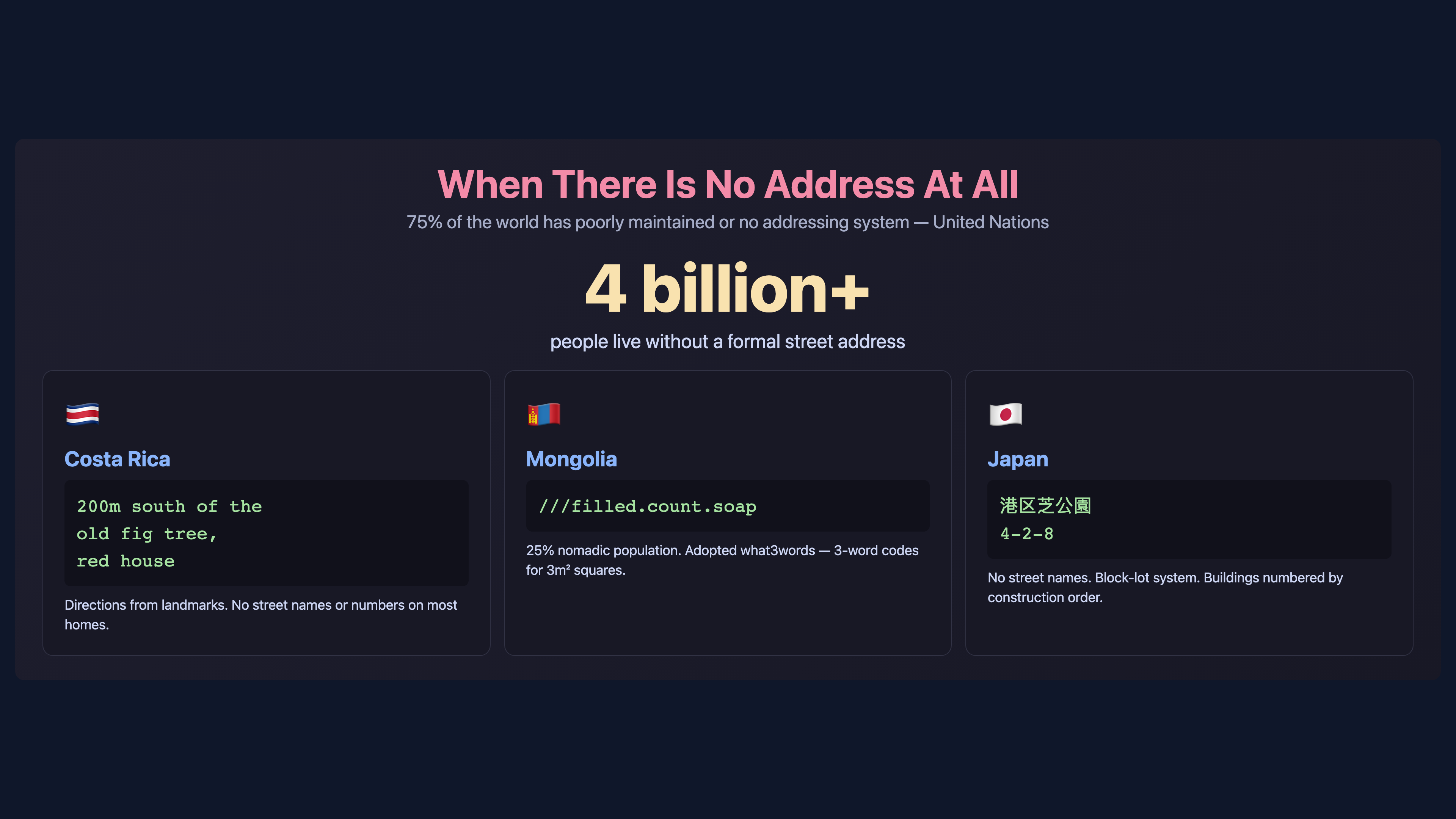
Here’s a statistic that should stop you in your tracks: approximately 4 billion people on Earth live without a formal street address. Not a bad address. No address at all. No street name, no house number, no postal code.
In Costa Rica, the official address system uses landmarks. A legal, government-recognized address might read: "De la antigua higuera, 200 metros al sur y 50 metros al este, San José." Translation: "From the old fig tree, 200 meters south and 50 meters east, San José." This is not informal directions — this is the actual mailing address. The postal service delivers to it. Banks accept it. It appears on property deeds.
The problem? The fig tree was cut down in 1996. But the address persists. Costa Ricans still give directions relative to landmarks that no longer exist. "From where the Burger King used to be" is a legitimate navigational reference. The address system has a memory longer than the physical landscape.
Mongolia took a different approach. With a population density of 2 people per square kilometer in most of the country, traditional addressing is impossible — there are no streets to name. In 2016, Mongolia adopted What3Words, a system that divides the entire planet into 3-meter squares, each assigned a unique three-word combination. Your address might be "///filled.count.soap." It’s a real system, used by the national postal service. But it means a geocoder must now understand that three English words separated by dots represent a physical location in Mongolia.
Japan presents yet another variation. Japanese addresses don’t use street names at all in most cases. Instead, they use a hierarchical system of districts (chō), blocks (banchi), and building numbers (gō). The building numbers reflect the order of construction, not the position on any street. Building 3 might be between Building 15 and Building 8 because that’s when it was built relative to its neighbors. Delivery drivers in Japan navigate by landmarks and local knowledge, not by sequential numbering — which is why detailed maps are printed on every Japanese business card.
When the Number Means Something Completely Different
Perhaps the most treacherous aspect of house numbering is that the same format — a simple integer — means fundamentally different things in different countries.
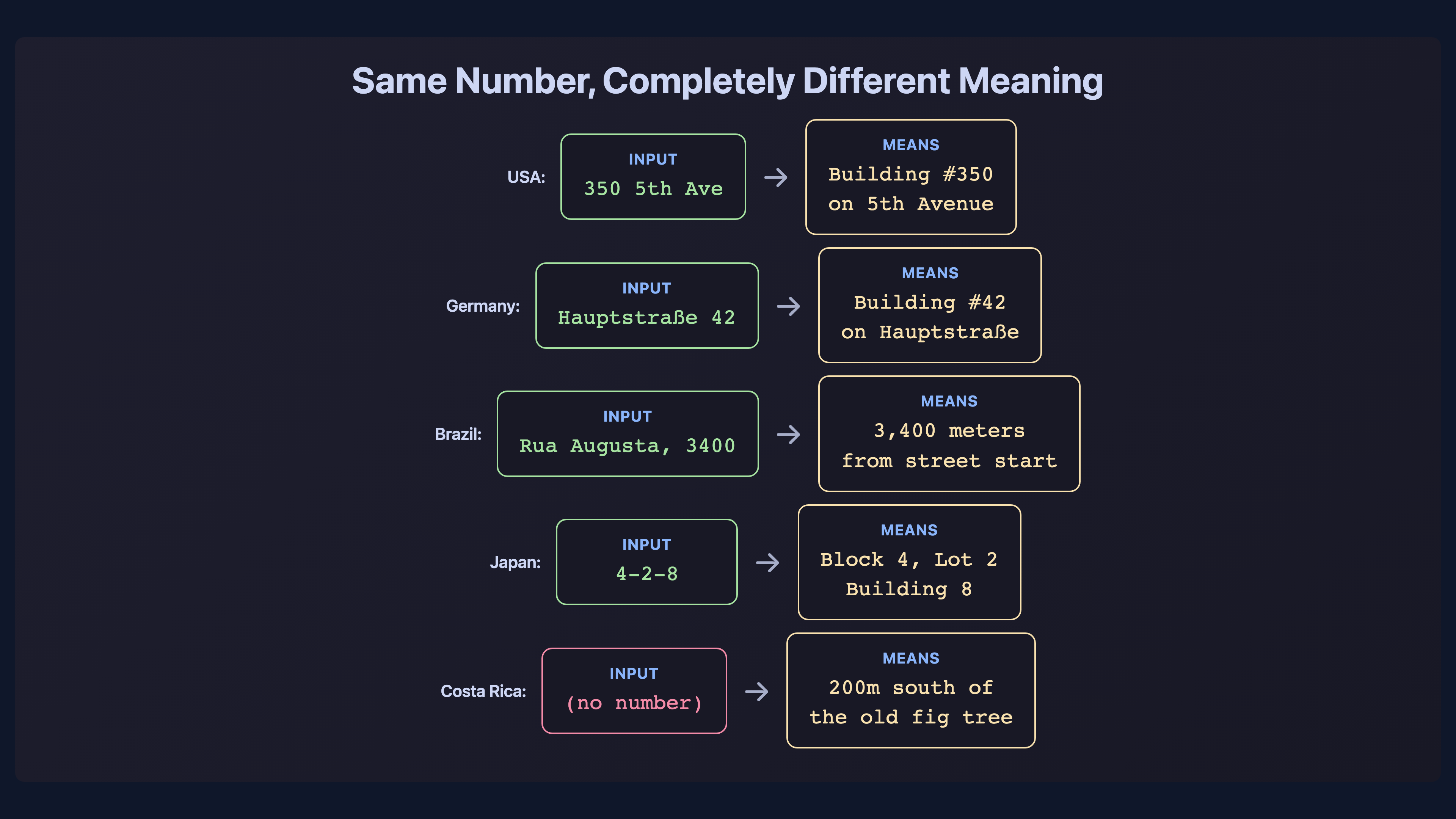
Take the number 350. In the United States, "350 Fifth Avenue" means the 350th address on Fifth Avenue, counting from the southern end of the street. The number is sequential, predictable, and monotonically increasing. In Germany, "Hauptstraße 42" means house number 42, but German streets often number odd addresses on one side and even on the other — so 42 is across the street from 41, not next to it. In Brazil, "Avenida Paulista, 3400" means 3.4 kilometers from the start of the avenue. In Japan, "港区苝4-2-8" means district 4, block 2, building 8 — and building 8 was the eighth one built in that block, possibly in 1973.
Same data type (a number), same position in the address string, completely different semantics. This is why naive geocoding fails. A system that treats all house numbers as sequential integers will misplace every Brazilian metric address, every Japanese block-lot, and every Austrian slash-notation dual number. The geocoder must know the country before it can interpret the number. And it must know the country’s specific numbering tradition — which may vary by city, by era, or by street.
In Queens, New York, the hyphenated format adds another layer. "25-11 Queens Boulevard" doesn’t mean house 25, apartment 11. It means block 25, lot 11. This format exists only in Queens (and parts of other New York boroughs). A geocoder that encounters "25-11" must know this is a Queens-style block-lot, not a range, not a fraction, and not a typo. Context isn’t just helpful here — it’s mandatory.
Why This Matters for Geocoding
Every house number format in this article represents a parsing decision a geocoder must make correctly. One wrong interpretation and the result is meters — or kilometers — from the actual location. A delivery goes to the wrong building. An emergency response arrives at the wrong block. An insurance policy prices against the wrong flood zone.
This is not a theoretical concern. In production geocoding systems processing millions of addresses daily, house number misinterpretation is the single largest source of precision errors. Not misspelled street names. Not wrong postal codes. House numbers. Because every other address component has relatively consistent formatting within a country — but house numbers break every rule.
CSV2GEO handles this complexity with a database of 744M+ addresses across 200+ countries, using eight different search strategies tried in order from most precise to least. The system doesn’t just match strings — it understands that "43-45" in Germany is a range, that "4-2-8" in Japan is a block-lot, that "3400" on Avenida Paulista is a metric distance. Each country’s addressing conventions are encoded into the matching logic.
You can test this yourself. Upload a CSV with international addresses at csv2geo.com/batchgeocoding — 100 rows per day, free, no account required. Or integrate the CSV2GEO API with 18 endpoints and 1,000 free requests per day. Get your API key at csv2geo.com/api-keys.
Series Navigation
The house number problem is just one piece of the puzzle. Address formats vary not just in how they number buildings, but in every component — street types, name order, postal codes, and thousands of cultural conventions.
Part 1: The Big Thesis
Address to Coordinates: Will Geocoding Decide the War?
The 2,000-year history and why it matters for AI.
Part 2: You Are Here
The House Number Problem: Why "123" Is Not What You Think
20+ house number formats and why they break geocoding.
Part 3: Coming Next
200 Countries, 200 Ways to Write an Address
Street types, name order, postal codes, and 135,000 combinations.
Part 4: Coming Soon
How to Convert Any Address on Earth to Coordinates
The practical guide with free tools, API, and Python SDK.
Frequently Asked Questions
How many house number formats exist worldwide?
There are over 20 documented house number formats worldwide, including simple sequential numbers (USA), number-after-street (Germany), metric distances (Brazil), block-lot systems (Japan), landmark-based addressing (Costa Rica), dual numbering with slashes (Austria/Czech Republic), and construction-order numbering. Many countries use combinations of multiple formats.
Why does Japan not use street names?
Japanese addressing uses a hierarchical system of districts (chō), blocks (banchi), and building numbers (gō) instead of street names. Buildings are numbered by construction order, not position. This system evolved from historical land registration practices. Only major thoroughfares have names, and even those are rarely used in addresses. Navigation relies on landmarks, maps, and local knowledge.
What is a metric house number?
In Brazil and some other countries, the house number represents the distance in meters from the start of the street. "Avenida Paulista, 1578" means the building is approximately 1,578 meters from where Avenida Paulista begins. This system is practical for navigation (you always know how far you need to travel) but challenging for geocoders that expect sequential numbering.
How do 4 billion people live without addresses?
Approximately 4 billion people worldwide lack a formal street address. They navigate using landmarks, local knowledge, informal directions, or alternative systems like What3Words (adopted by Mongolia’s postal service). In Costa Rica, legal addresses reference landmarks that may no longer exist. In many developing nations, rapid urbanization outpaces formal addressing infrastructure. This creates challenges for emergency services, delivery, banking, and governance.
Can geocoding services handle all house number formats?
Most geocoding services handle 5–10 common formats well but struggle with uncommon ones. CSV2GEO supports 200+ countries with 744M+ addresses and uses eight search strategies to handle diverse formats including block-lot (Japan), metric distances (Brazil), dual numbering (Austria), and hyphenated block-lot (Queens, NY). Upload a test file at csv2geo.com/batchgeocoding to see results for your specific addresses.
What is the Queens hyphenated address format?
In Queens and parts of other New York City boroughs, addresses use a hyphenated format like "25-11 Queens Boulevard." The first number (25) identifies the block and the second (11) identifies the lot within that block. This format is unique to New York City and must be recognized as a block-lot system, not a range or fraction. Geocoders must apply borough-specific parsing rules to interpret these addresses correctly.
I.A. — CSV2GEO Creator. The house number problem is just the beginning. Wait until you see what postal codes do.
Related Articles
Use our batch geocoding tool to convert thousands of addresses to coordinates in minutes. Start with 100 free addresses.
Try Batch Geocoding Free →